Toolchains leave artifacts
Node.js, Flutter/Dart, Gradle and project-linked Xcode DerivedData create generated artifacts across a Mac.
ExactDisk maps Node.js, Flutter/Dart, Gradle and project-linked Xcode DerivedData to your projects—and explains reclaim risk.
See exactly where the space went—in the real app.
Actual macOS app captures using demo projects. Explore storage, review the reclaim checks, and see how each outcome is explained. Select any screenshot to enlarge it.
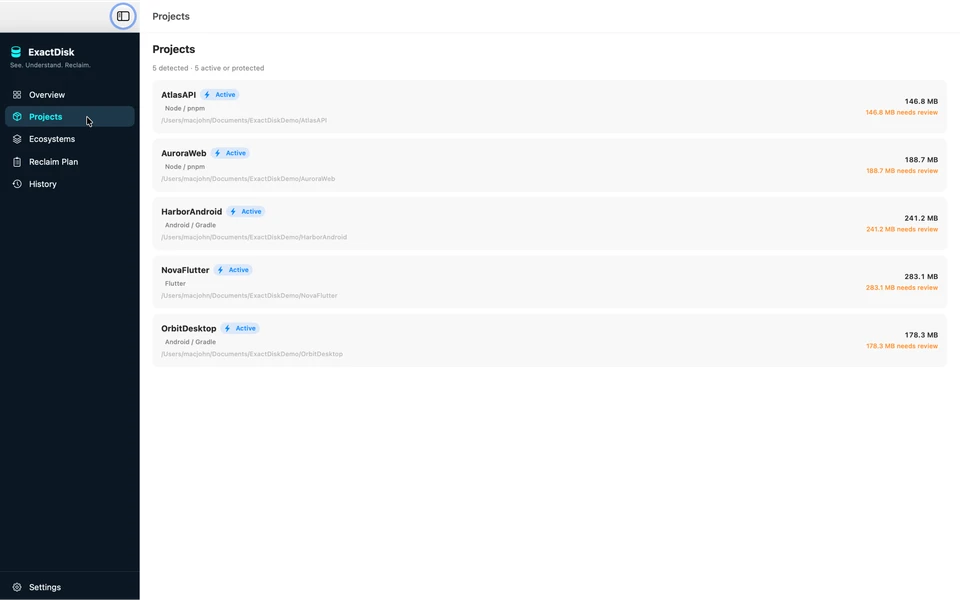
See which project owns the space.
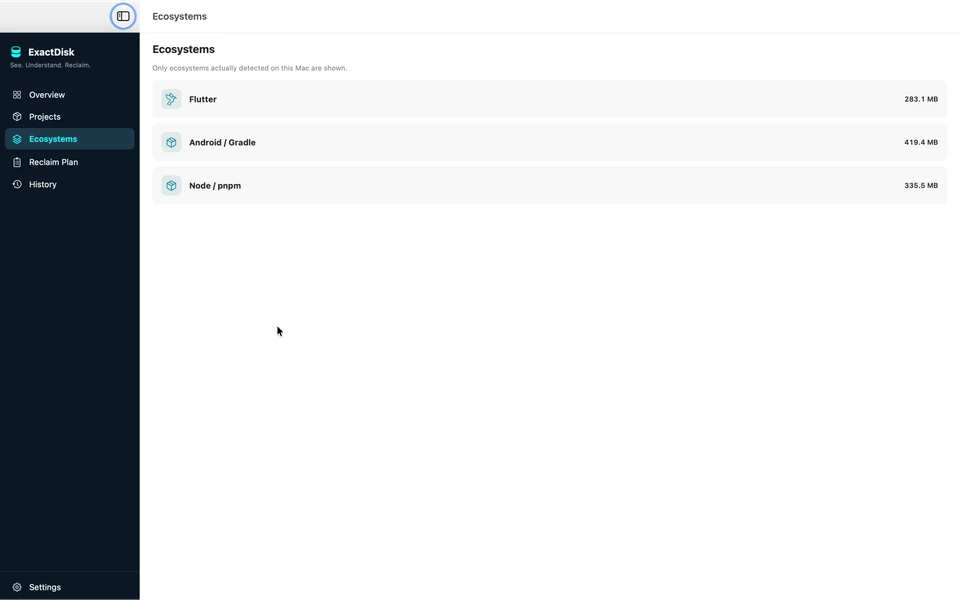
Compare the developer tools detected on your Mac.
Confirm the selected items before moving them to macOS Trash.
Offline scanning, no account, and folders you choose.
Review outcomes and observed storage after a matching rescan.
Reclaim waits while visible developer tools are open.
A 60-second quiet window is one of the checks before reclaim.
Changes after a scan disable reclaim until you rescan.
A used plan cannot be replayed. Rescan to build a new one.
Know what created it, and what it would cost to remove.
Build output, package installs, caches and generated files spread across a Mac. A folder and byte count rarely tell you what created them—or whether cleanup is a good idea.
Node.js, Flutter/Dart, Gradle and project-linked Xcode DerivedData create generated artifacts across a Mac.
One development tool can consume space across many repositories. Project totals alone miss that bigger picture.
Some artifacts rebuild easily. Others are shared, active, or authoritative project data. They should not look the same.
ExactDisk keeps the project as the main view, with an ecosystem lens that aggregates a toolchain's footprint across projects.
See storage associated with each project.
Current production detector support.
Scanning and planning are read-only. Reclaim requires your confirmation and a final validation before anything moves.
You select the folders ExactDisk may inspect.
Read-only analysis maps projects and developer storage.
Rules explain risk and storage attribution.
Fresh checks can block an item if conditions changed.
Approved items go to macOS Trash, never silent permanent deletion.
Only the narrow eligible set moves—to macOS Trash, after fresh checks.
Classification is explicit and rule-based. The most protective applicable classification wins.
Disposable output with low recreation cost and a rule showing it is non-authoritative.
Can be recreated from project or tool inputs, though rebuilding may take time or compute.
Context makes automatic removal too uncertain or potentially disruptive.
Source, credentials, signing assets, repository-critical data and items outside approved scope.
ExactDisk uses deterministic rules and documented safety signals. When a required check is unavailable or ambiguous, reclaim is blocked.
The Mac App Store design uses the App Sandbox and user-selected folder access. Permission denial reduces visibility; it does not make cleanup more permissive.
Visible developer apps, filesystem activity, Git evidence and project protection signals can block reclaim when a project appears active or uncertain.
ExactDisk 1.0 requires 60 seconds without relevant writes as one additional conservative signal—not proof that a project is inactive.
ExactDisk checks paths, identity, scope, permissions and protection state again immediately before acting. Changed or stale items are skipped.
In ExactDisk 1.0, one-click reclaim is limited to project-local, exclusively attributed Safe or Rebuildable artifacts. Shared, global, unattributed, Review, Never-touch and worktree items are excluded.
Approved items move to macOS Trash. If that operation fails, ExactDisk reports it and leaves the item in place.
Core scanning and classification are local-first and offline-capable. No account, cloud service or project upload is required.
Understand storage in the context of the projects that use it.
See how development technologies add up across projects.
Review the rule and risk behind each eligible recommendation.
See what ExactDisk attempted; history never authorizes a later cleanup.
Compare expected and observed storage after a matching rescan.
Light and dark mode, keyboard accessibility and VoiceOver support.
No. The current contract moves approved reclaim items to macOS Trash. If Trash fails, ExactDisk reports the failure and leaves the item in place; there is no silent permanent-delete fallback. Items remain recoverable through normal Trash behavior until you empty it.
Source files and other authoritative project data are classified Never touch. ExactDisk 1.0’s Mac App Store reclaim rules are narrower: only project-local Safe or Rebuildable artifacts are eligible for one-click reclaim. Review and Never-touch items cannot be upgraded by confirmation.
No. Deterministic detectors, attribution rules, risk levels, activity and protection evidence, path checks and fresh pre-execution validation govern reclaim. An LLM does not authorize deletion.
No. Scanning and planning are non-destructive. A reclaim action requires explicit confirmation and fresh safety checks immediately before the item moves to Trash.
Reclaim is blocked for the changed item. Relevant filesystem activity after the scan invalidates the clean state and causes the item to be skipped.
ExactDisk 1.0 uses a bounded 60-second write-quiet window. It is an additional conservative signal, not proof that the project is inactive. Relevant writes block reclaim until a fresh valid scan/session.
No. The Mac App Store sandbox cannot inspect every process working directory. A headless or read-only process that creates no observable filesystem write may not be detectable. ExactDisk protects against observable and ambiguous sandbox-compatible signals and limits reclaim to project-local Safe or Rebuildable artifacts.
It blocks reclaim. Unavailable app information, interrupted or incomplete filesystem monitoring, lost folder permission, project or volume mismatch, stale sessions and other failed checks make ExactDisk fail closed.
Git worktrees are Review by default and stay outside the one-click reclaim scope in ExactDisk 1.0. Shared, global or unattributed storage is not treated as belonging exclusively to one project, so it is also excluded from the ExactDisk 1.0 reclaim gate.
No. Confirmation is required for an otherwise valid reclaim, but it cannot override a safety block. If an item becomes uncertain or fails revalidation, ExactDisk skips it.
Not for the ExactDisk 1.0 Mac App Store release. ExactDisk uses the App Sandbox with user-selected folder access. You choose what it may inspect; permission denial reduces visibility and does not make cleanup more permissive.
Core scanning and classification are local-first and offline-capable. Core operation does not require an account, cloud sync, analytics, telemetry, source-code or inventory upload, or an external AI API. Project paths, tool metadata, measurements and reclaim history are intended to stay on-device.
It prefers filesystem and tool metadata over source-file contents and does not need source-code upload for core operation. Source contents are not intended to be persisted.
Get ExactDisk for macOS from the Mac App Store today.
Get ExactDisk on the Mac App Store